|
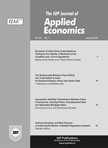
Dynamics of India-China Trade Relations: Testing for the Validity
of Marshall-Lerner Condition and J-Curve Hypothesis
--Bibekananda Panda and D Rama Krishna Reddy
Recent devaluation of Chinese yuan has threatened the stability of global financial system and has invited unwarranted currency war. China is India’s largest goods trading partner and India has a whopping trade deficit (US$49 bn in FY15) with China on account of rising imports and dismal exports. The recent devaluation of yuan (around 4% in two days, August 11-12, 2015) would make Chinese exports more competitive than that of India, which in turn would have a negative impact on India’s exports. Depreciation of Indian rupee by virtue of its global integration though has nullified the devaluation effect of yuan, but the growing trade deficit of India with China is still a concern. This study aims to provide empirical insights on whether real depreciation of Indian rupee is an effective way of improving the trade deficit with China. Using annual data from World Bank and UN Comtrade from 1987 to 2014, the paper validates Marshall-Lerner condition and J-Curve effect for India. Bounds test to cointegration approach based on Autoregressive Distributed Lag (ARDL) model and error correction of ARDL model are employed in the study. The bounds test result shows evidence of long-run relationship between trade balance, domestic income, foreign income and real exchange rate. Moreover, the estimated long-run ARDL model rejects the validity of Marshall-Lerner condition for Indian economy. Finally, short-term dynamics obtained from the estimation of error correction model show that there is no J-curve effect for India. Hence, depreciation of rupee is not expected to yield the desired result in correcting the trade deficit with China.
© 2016 IUP. All Rights Reserved.
The Relationship Between Fiscal Deficit and Trade Deficit in India:
An Empirical Enquiry Using Time Series Data
--T Rajasekar and Malabika Deo
Starting with a very simple question—Is there any relationship between trade deficit and fiscal deficit in India?—the present study attempts to evaluate the long-run relationship and causality between trade deficit and fiscal deficit with econometric models such as unit root, cointegration, error correction model and Granger causality test over the period 1980-2014. Individual modeling suggests that there exists a longrun relationship and causality between trade deficit and fiscal deficit and other macroeconomic variables during the study period. Overall results imply that fiscal deficit and macroeconomic factors have cointegrating relationship with trade deficit and should be given serious attention in the attempt to decrease trade deficit and fiscal deficit in India in future.
© 2016 IUP. All Rights Reserved.
Asymmetric Volatility Transmission Between Home Foreclosures,
Housing Prices, Unemployment Rate and Adjustable Mortgage Rates
--Emmanuel Anoruo and Muhammad Mustafa
This paper uses the EGARCH model to investigate the volatility spillovers between home foreclosures, adjustable mortgage rates, housing prices and unemployment rate for the US. The results provide evidence of volatility spillover effects from adjustable mortgage rates, home foreclosures and unemployment rate to housing prices. The results further indicate the presence of volatility spillover effects from housing prices to home foreclosures. However, unemployment rate is affected only by volatility spillover from adjustable mortgage rates. These results imply that to mitigate the problem of volatility in housing market, the policy maker should coordinate adjustable mortgage rates, housing prices and home foreclosures. In other words, the authorities cannot effectively use foreclosure strategies to influence the housing market without considering adjustable mortgage rates, housing prices and unemployment rate.
© 2016 IUP. All Rights Reserved.
Technical Analysis and Risk Premium in Indian Equity Market:
A Multiple Regression Analysis
--Sibanjan Mishra
The purpose of this paper is to estimate the effectiveness of technical trading strategies and examine the extent to which trading profitability using technical analysis indicators explains the ‘risk premium’ or ‘risk compensation’ for investing in equity markets as against assets that are relatively risk-free using multiple regression analysis. The technical indicators selected for the analysis are Bollinger bands (volatility indicator), moving average (trend indicator), Relative Strength Index (momentum indicator), and Elliot wave theory (mass psychology indicator). The paper finds evidence for risk premium being explained by technical indicators. The technical trading strategy based on trend, momentum, volatility indicators, including the Elliot wave theory has the ability to explain the excess return of a stock. The findings have important implications for traders and practitioners. A positive relationship implies that technical indicators can be explored while evaluating strategies for investment. So, it suggests that traders, retail investors and fund managers, while evaluating portfolios, can rely on technical indicators-based trading strategies other than fundamental analysis.
© 2016 IUP. All Rights Reserved.
|